

Why the DW-10 opts for a catapult launch and parachute landing: Maximum safety for every fixed-wing drone professional
Every fixed-wing drone professional knows it: the most critical moments of a flight are takeoff and landing. Even the most advanced autonomous flight can go up in smoke due to a botched hand launch or a hard landing on rough terrain.
At Dutch Wing we believe that professional drone operations must be robust, reliable, and accessible. That is why we have chosen a proven combination for our DW-10: a catapult launch and a parachute landing.
In this blog, we explain why we made this deliberate choice and how it drastically reduces risks.
The danger of hand launching and manual landings
Traditional fixed-wing drones are often launched by hand. This brings significant disadvantages and risks:
Dependence on pilot skills A hand launch requires physical effort and precise timing by the pilot. In adverse weather conditions or heavy gusts of wind, a failed takeoff is right around the corner.
Safety risks Propellers running at full throttle close to the operator's hands pose a constant risk of injury.
Material damage: A 'belly landing' on unpaved terrain, such as stones, branches, or hard clay – leads to structural wear, damaged wings, and broken sensors over time.
The power of the catapult: Always a controlled takeoff
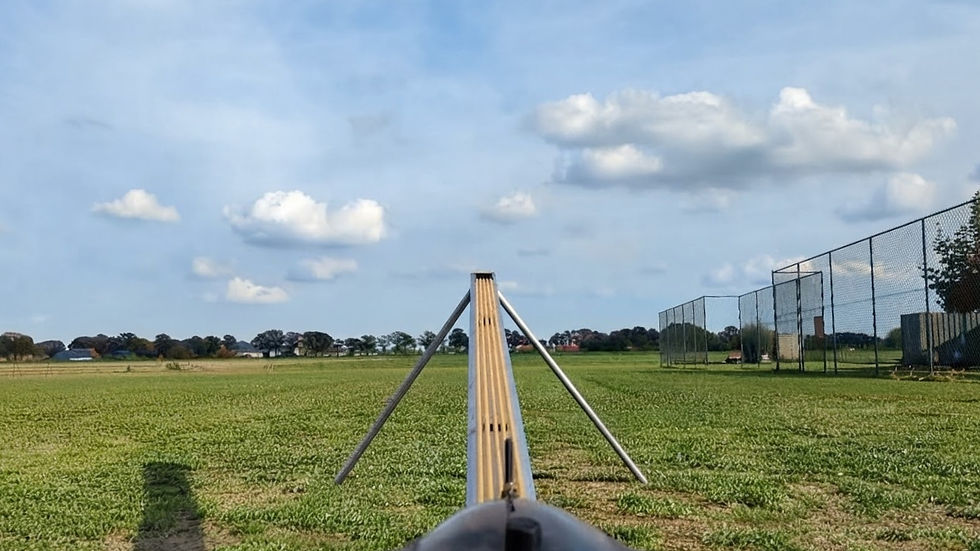
To completely eliminate the human factor during takeoff, the DW-10 uses a specially designed catapult system.
Consistent initial speed The catapult launches the DW-10 with exactly the right acceleration and speed. This guarantees a stable and predictable transition into flight.
Safety for the operator The motor only starts once the aircraft is safely clear of the rail, eliminating any risk of contact with the propellers.
Weather independence Even in challenging conditions, the mechanical launch ensures a reliable takeoff without the pilot needing to exert physical force.
Landing softly thanks to the emergency parachute and smart navigation
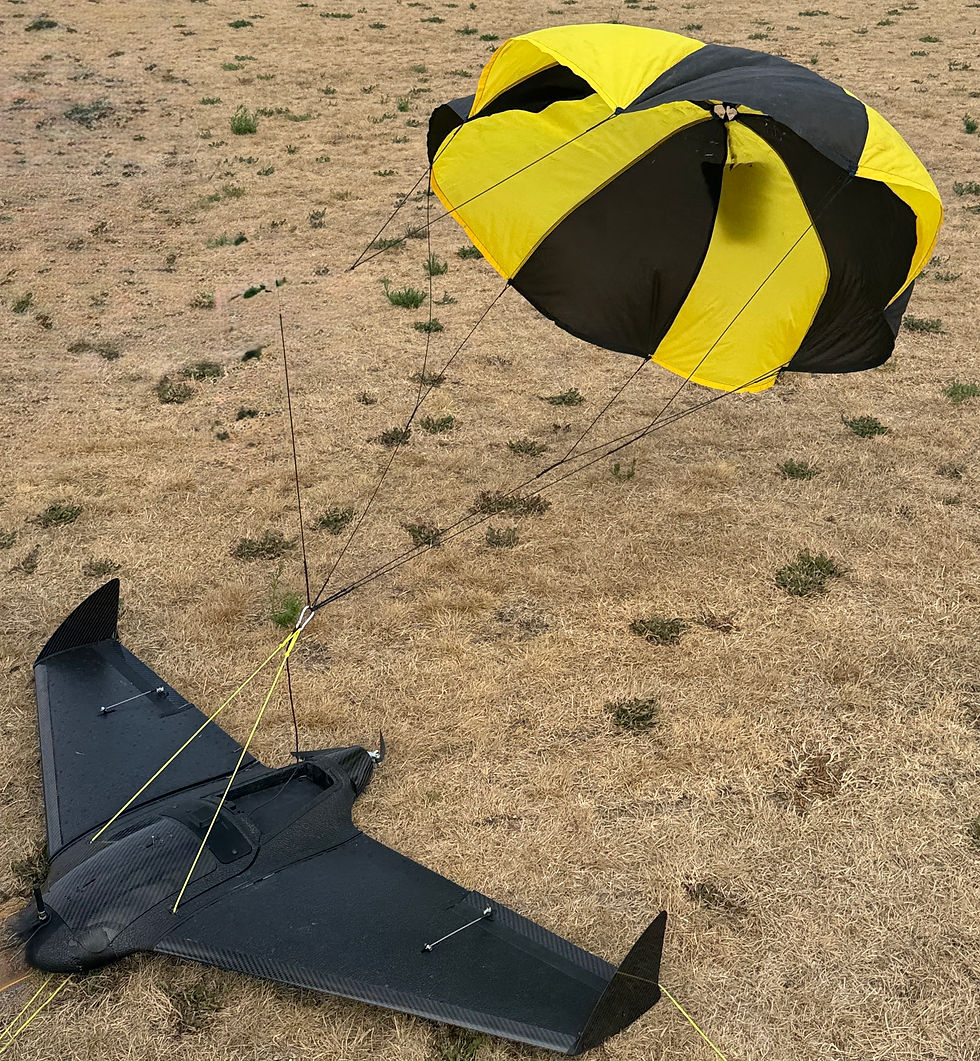
While the takeoff needs to be powerful and controlled, the landing requires maximum protection for both the airframe and the valuable payload on board. The DW-10 combines a parachute with advanced onboard technology:
Smart calculation for a pin-point landing During flight, the DW-10 continuously calculates the current ground conditions and airspeed. Based on this, the autonomous system determines the exact deployment moment, ensuring the drone lands as close as possible to the designated landing spot.
Minimal impact force The parachute slows down the descent so that the drone lands softly, regardless of the terrain (grass, asphalt, or uneven fields).
Extended lifespan By avoiding hard impacts, the structure of the DW-10 remains intact, and sensitive sensors and cameras last significantly longer.
No specialized runway needed Just like the takeoff, the DW-10 does not require a long runway or clear approach path. A compact open space is all it takes.
Lower risk, maximum reliability
By choosing a catapult and a parachute, the DW-10 minimizes the chance of crashes during the most critical moments of the mission. This not only lowers operational costs and downtime due to repairs, but also ensures that operations can be carried out more safely and efficiently, regardless of the on-site pilot's experience.
Would you like to know more about the specifications of the DW-10 and how our launch and landing system can strengthen your operations? Contact us for a no-obligation consultation or live demonstration.


Comments